Akshay Joshi Semester 2 Project Blog
18 March 2025
The Eden Estuary has been shaped by centuries of human intervention and natural evolution. As new conservation techniques are implemented in the estuary, these efforts would benefit from the knowledge and record of past conservation efforts. Future decision-making and research greatly benefit from being informed of the successes and shortfalls of past conservation. However, a critical gap here is the inaccessibility of historical documents. Given the niche location and historic nature of conservation efforts, these details have been recorded in physical archives, which are preserved in Glenrothes. Unfortunately, this information is not available electronically, which is a limiting factor for future research and conservation. Here, my Semester 2 project aims to digitise archival information on flood management strategies in the Eden Estuary.
This plan for this project stems from primary and secondary research conducted across the VIP. My focus last semester was on understanding conservation strategies in the Eden Estuary, which balances the dual objectives of protecting economic (e.g., golf courses) and ecological interests.
The primary research for this project included stakeholder engagement during multiple field trips.
|
Stakeholder engagement experience |
Lessons Learnt |
|
Visiting the Eden Estuary Centre and talking to Dominique Rye |
This was a formative experience in the project and helped provide a foundational understanding of the Eden Estuary and conservation efforts. I was far from identifying a personal project at the time and took this opportunity to simply learn about the Estuary, its ecosystem and the intersection between people, communities and the environment. |
|
Visit to the D’Arcy Thompson Simulator and spoke to Moya Crawford and her team |
At this point, I knew that I wanted my project to be vaguely around stakeholder involvement in conservation. Here, it was very valuable to hear Moya talk her challenges in getting landowners onboard and how conservation navigates often competeting stakeholder priorities. A key takeaway was the emphasis on technology as a tool in helping visualise and inform conservation strategy. |
|
Visit to Green Shores Polytunnel & Eden Estuary’s saltmarshes.
|
I got the opportunity to talk to Dr Clare Maynard, a key figure in Eden Estuary conservation, and whose work was the backbone of my literature review. A key takeaway for me was learning that hybrid conservation efforts had long been attempted at the estuary with varying success. It was interesting to hear about the failure of bio-rolls in preventing saltmarsh erosion, as this was a solution that other conservation literature was promoting. |
Secondary research involved a) conducting a literature review to understand the current conservation landscape and potential next steps; and b) Secondary research also involved examining the OnFife archives collection records to identify which specific records our ‘archives group’ wanted to access and contacting the centre.
Drawing on my semester 1 literature review
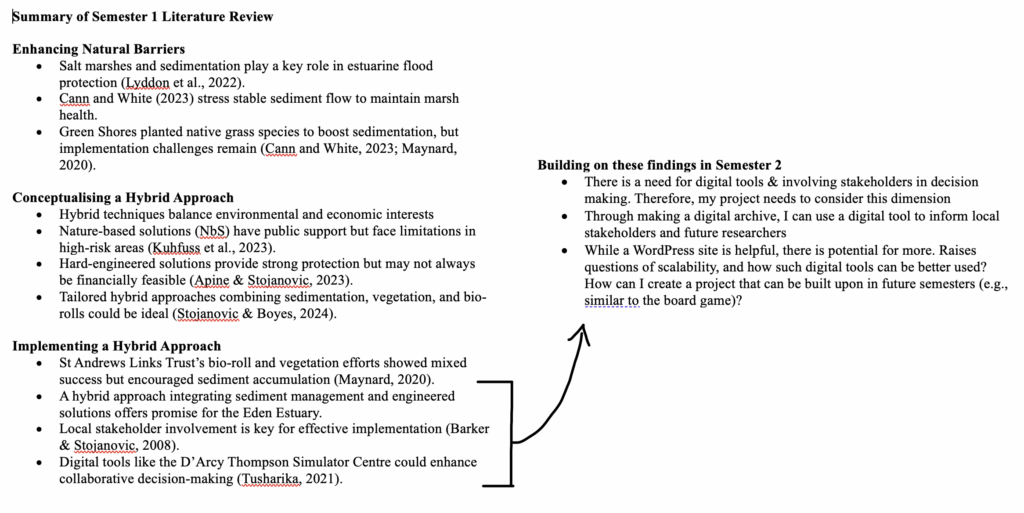
This primary and secondary research has been in line with my project plan, which is shown below.

Tidying up WordPress
I have decided to take the responsibility of being the lead editor of our VIP. Whilst I have no prior experience with web design, I have a keen interest in developing our site and believe that it is important to put out the work done by my colleagues in this project. The first priority was tidying up the St Andrews VIP webpage. Initially, the sub-pages within our VIP were listed as individual projects, which a) made it hard to present VIP work, and b) made the entire VIP page look cluttered. This has since been changed, with our project web pages only popping when the ‘Looking after Eden’ page is clicked.
Showcasing student contributions
Next, I made changes to the ‘Our Research Projects’ subpage, which aims to showcase student work. My next steps for this page will be adding the blogs of my colleagues to this page and securing the permission to present the work of students from previous semesters (since Jan. 2023).
Developing my project page
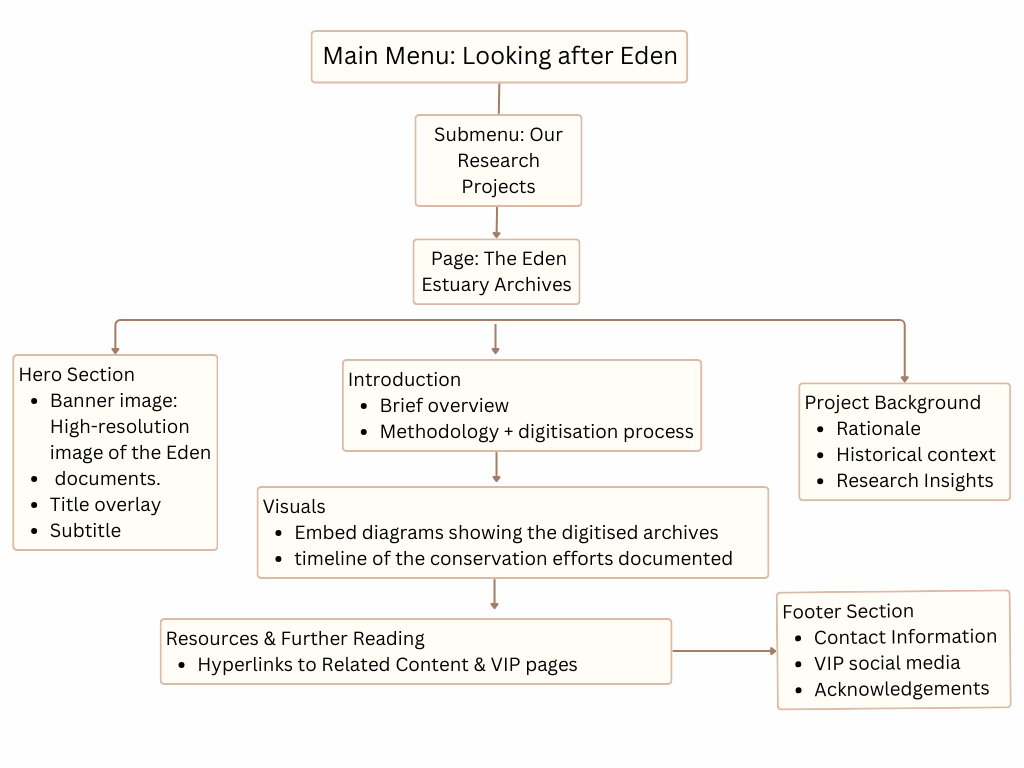
Next, I created the webpage for presenting my digitised archives. Given that I am awaiting permission to visit the archives, my project has been put on the back burner as I explore options for the shared WordPress. Once permission is secured, I will be populating my project page with the following outline.
Web Outiline
Next Steps for the Semester
I have thoroughly enjoyed this semester of the VIP! It has been great to find a clear vision and apply my ideas. As the semester progresses, I hope to take big strides with my project and our shared WordPress site. My immediate priorities for now are:
- Secure permissions from VIP supervisors, current cohort and previous students, and display their work on the ‘Our Research Projects’ page. Currently, several pages have a “contact [email protected]” note and I aim to populate these pages as soon as possible. Once the intermediate assessments are complete, I plan to extend the ‘Our Research Projects’ section to include contributions from others in our cohort. This will enhance the collaborative spirit of our VIP.
- Schedule a meeting and secure appropriate permission from the archives. From here, the main task is to collate and transcribe the archives. Although this step has taken a back burner amid other responsibilities, it is the heart of the project.
In the meantime, I will be continuing to update the VIP page and look forward to seeing where things go!